What Coloring Research Can and Cannot Tell Us About Anxiety
A careful look at coloring and anxiety studies: what small trials actually show, where the evidence is thin, and how to color as grounded self-care.
Why We're Asking This Question Now
It is tempting to reach for a tidy headline: coloring calms anxiety. The truth, as it usually is with human behavior, is more textured. A handful of studies have looked at coloring and anxiety in recent years, and they are genuinely interesting. But interesting is not the same as settled. At Coloring Habitat, we would rather walk through what the research actually measured, who it studied, and where its edges are, than hand you a slogan.
This matters because coloring sits in a strange cultural spot. It is simple enough to feel almost too ordinary to study, yet popular enough that people want to know if the quiet hour they spend with colored pencils is doing something measurable. So let's look at four studies, what they found, and just as importantly, what they did not find.
What the Research Actually Looked At
Hospitalized adults and mandala coloring
A 2026 meta-analysis in BMC Complementary Medicine and Therapies pooled seventeen studies and nearly a thousand hospitalized patients to look at mandala coloring's effects on psychological and physiological symptoms (pubmed-mandala-meta-hospital). The pooled results showed meaningful reductions in anxiety and stress scores, along with improvements in well-being and hope. That sounds encouraging, and it is worth sitting with. But the authors were candid about the catch: the certainty of evidence was rated low using the GRADE framework, and heterogeneity across the included studies was substantial, meaning the trials measured things differently and produced results that did not line up neatly. No significant effects turned up for resilience, pain, fatigue, nausea, comfort, or vital signs. This is a dataset about people recovering in hospital beds, not a general population, and it does not tell us how coloring behaves in a living room on a Tuesday night.
Older adults and mandala-based art
A separate 2026 systematic review and meta-analysis in Frontiers in Psychology examined nine randomized controlled trials involving 648 adults aged 55 and older, comparing mandala-based art interventions (which included both structured coloring and more open-ended drawing or painting) against control conditions (pubmed-mandala-meta-older). The pooled effect sizes for both anxiety and depressive symptoms were large on paper. However, the certainty of evidence was rated very low, and the authors were explicit that heterogeneity was high enough, and the number of trials small enough, that the subgroup findings should be treated as hypothesis-generating rather than conclusive. In plain terms, this is a promising early signal, not a verdict.
University students and a randomized comparison
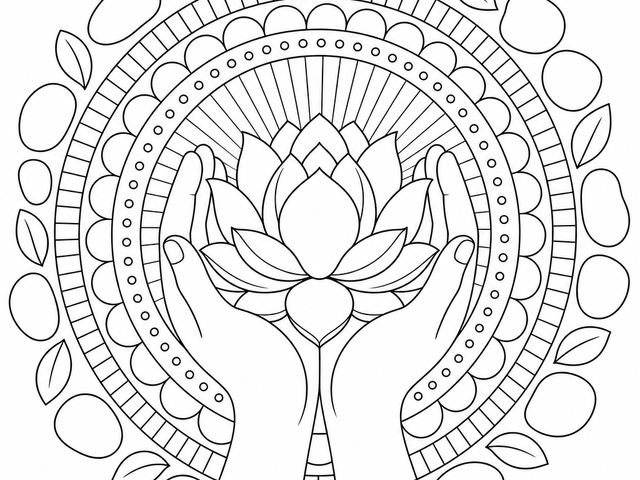
A smaller, single-session randomized controlled trial at Universiti Sains Malaysia offers a useful contrast (pubmed-mandala-rct-students). Sixty students with moderate to high anxiety were split into two groups: one colored a geometric mandala for 20 minutes, the other colored a blank circle. Anxiety dropped in both groups, with no significant difference between them. EEG recordings did show that the mandala group had a distinct increase in frontal alpha power, a pattern often associated with relaxed, focused attention. But the anxiety reduction itself was not unique to the mandala. This detail matters a great deal: it suggests that the simple act of coloring, rather than any particular pattern or design, may be doing the relaxing work, at least in this specific one-session context with young adults.
A related finding on open-ended art making
A smaller 2016 quasi-experimental study measured cortisol, a stress-related hormone, in 39 healthy adults before and after 45 minutes of open-ended art making (pubmed-art-making-cortisol). Cortisol levels dropped significantly, and participants described the session as relaxing and enjoyable. This study did not use coloring books specifically, had no control group, and was conducted with a small, healthy sample. It is a data point about art making broadly, not a coloring study, so we mention it as adjacent context rather than direct evidence.
What These Studies Cannot Tell Us
Small samples, single sessions, and wide confidence intervals
Across this body of work, a few patterns repeat. Many trials are small, often fewer than a hundred participants per comparison. Many measure only a single session, which tells us little about what happens after a week, a month, or a year of regular coloring. Confidence intervals are frequently wide, meaning the true effect could be considerably smaller or larger than the headline number suggests. And certainty ratings, when reported using formal tools like GRADE, have consistently landed at low or very low across these particular studies. None of this means the findings are worthless. It means they are early, and they should be read as early.
It is also worth noting that none of these studies measured anxiety disorders diagnosed through clinical evaluation; most relied on symptom scales completed before and after a session. That is a meaningful distinction between a self-reported dip in anxious feeling during a quiet activity and a clinically validated treatment effect.
Coloring is not art therapy
The American Art Therapy Association draws a clear line here: art therapy is a mental health profession practiced by credentialed clinicians trained to use art-making within a therapeutic relationship, and the association specifically cautions against labeling coloring books as art therapy (aata-art-therapy). Coloring can be a self-care activity, but it is not art therapy or a substitute for mental-health care. If anxiety is significantly affecting daily life, a conversation with a licensed professional is a more appropriate next step than any coloring page, however well designed.
Bringing This Into a Grounded Coloring Practice
None of this uncertainty needs to drain the pleasure out of sitting down with a coloring page. It just asks us to hold our expectations honestly.
Tactile specifics for a calmer session
- Choose a quiet, low-demand moment, not a task you're rushing through between obligations.
- Notice pencil pressure. A lighter touch on toothy paper lets color build in layers; heavier pressure flattens texture faster.
- Pick two or three colors before you start rather than reaching for the whole set. Fewer decisions can make the session feel calmer, independent of any claim about mandalas specifically.
- Work in short stretches, fifteen to twenty minutes, rather than forcing a long session. The hospital-based meta-analysis noted that brief and repeated sessions showed some of the stronger associations with reduced anxiety scores, even though the overall evidence was rated low.
- Let the page be imperfect. Formal elements like value, hue, and intensity exist on a spectrum of choices, not a single correct answer.
Reading future research with a clear eye
If you come across a future study claiming coloring reduces anxiety, it is worth asking: how many participants, was there a control group, was it a single session, and how was certainty of evidence rated. These questions are not cynicism. They are the same questions the researchers themselves are asking in their own limitations sections.
A Closing Thought
The honest summary is this: several small and moderate studies suggest coloring, including mandala coloring, is associated with lower anxiety scores in specific groups like hospitalized patients, older adults, and university students, but the evidence is still early, often low certainty, and does not show that any particular pattern works better than simple coloring itself. That is a reasonable foundation for a pleasant, low-stakes habit. It is not a foundation for medical claims.
We will keep an eye on how this research develops. In the meantime, we invite you to pick up a page, choose a color that appeals to you right now, and give yourself a short, unhurried stretch of time with it. Whatever the studies eventually settle on, that quiet pause is worth having on its own terms.