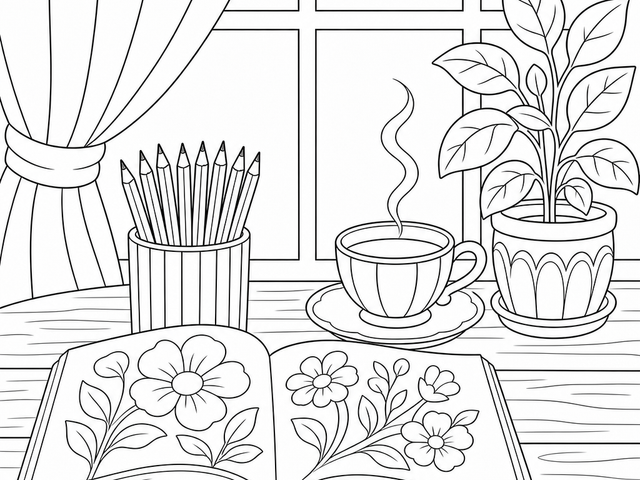
The Compact Coloring Kit: Trains, Flights, and Café Tables
Build a travel coloring kit that survives tray tables, wobbly café seats, and train aisles, with paper, pencil, and packing notes that actually hold up.
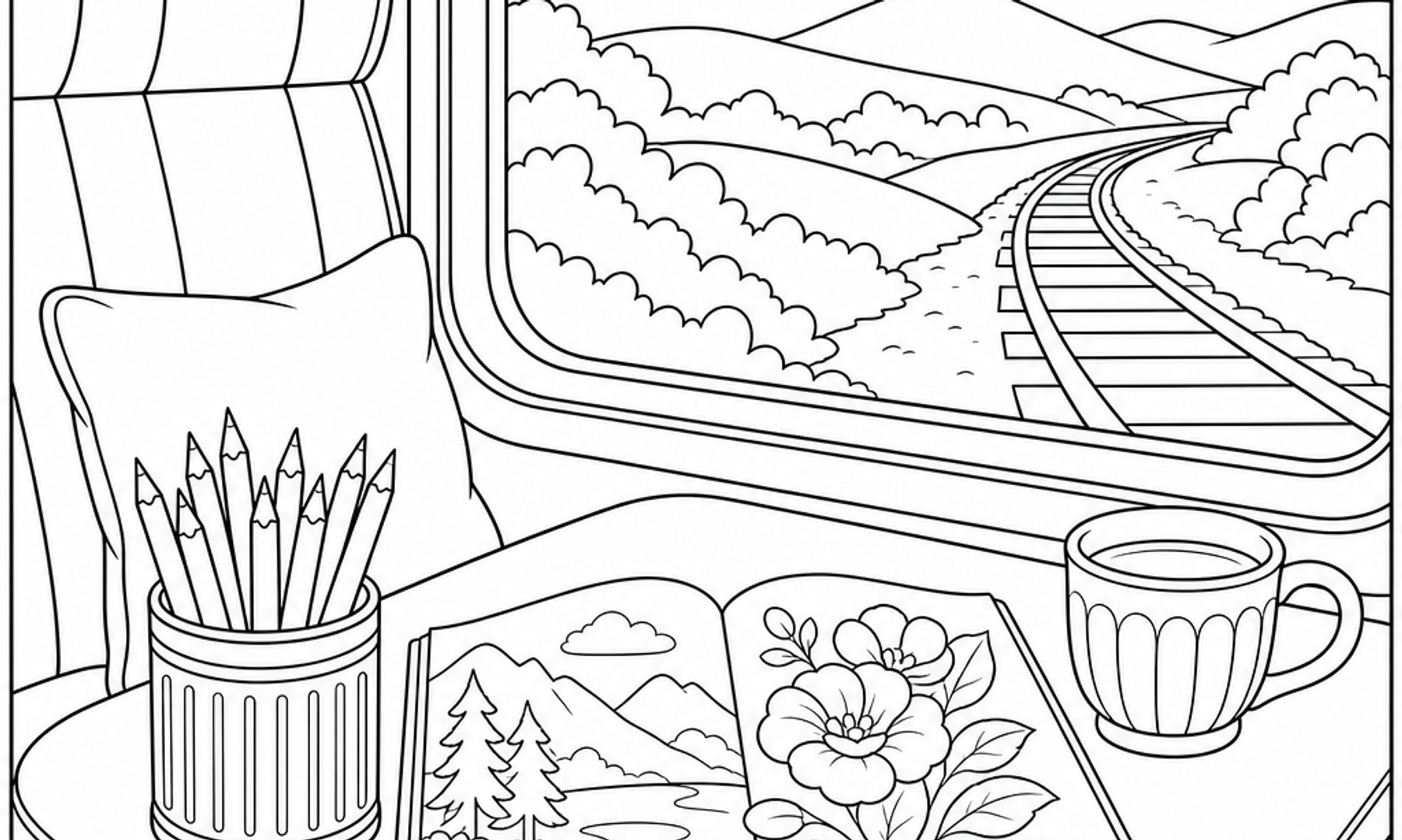
Why a Travel Coloring Kit Deserves Some Planning
There's a particular kind of quiet that settles in on a train platform, in a boarding line, or at a café table while you wait for a friend who's running ten minutes late. A compact coloring kit turns that in-between time into something you actually look forward to, rather than another stretch of scrolling. But coloring on the go asks a little more of your supplies than coloring at a desk. Pages flap in the wind off a passing train. Light shifts from window glare to dim café lamps. Space is whatever's left after your coffee cup and your bag.
This isn't about buying more stuff. It's about choosing the right few things and packing them so they survive a day of transit intact. Below, we'll walk through what to pack, how paper and pencil interact in motion, and how to build a short routine that works whether you have five minutes or fifty.
What Actually Belongs in a Portable Art Supplies Kit
The goal is a kit small enough to live in a jacket pocket or the front pouch of a bag, but complete enough that you're not missing a tool mid-page.
The Core Four
- A small coloring book or loose folded pages. Pre-cut or perforated pages travel better than a spiral-bound book that catches on everything in your bag.
- A tin of 12 to 24 colored pencils. More than that becomes cumbersome to sort through on a tray table; fewer and you may feel boxed in on color choice.
- A compact sharpener with a closed shavings chamber. Loose shavings in a bag are a genuine hazard to everything else you're carrying.
- A soft cloth or small eraser. Useful for lifting stray marks, though colored pencil erases less cleanly than graphite, so think of it as cleanup rather than correction.
Optional Additions Worth Their Weight
- A flat clipboard or stiff piece of cardboard cut to size, for a firm surface when there's no table
- A few blending pencils or a colorless blender if you already use one at home
- A small zip pouch to keep everything together and dry
Keep the whole kit under the weight and bulk of a paperback novel. If it's heavier than that, something gets left behind on the next trip, and usually it's the thing you needed.
Choosing Paper and Pencils That Travel Well
Material choice matters more away from home, where you can't just switch to a different pad if something isn't working. Legion Paper interviewed several colored pencil artists about what they look for in a surface, and a recurring theme was tooth, the slight texture that lets pencil pigment catch and layer. As artist Megan Seiter put it, she looks for paper that's "toothy without being heavily textured," and several artists mentioned testing scraps before committing to a full piece. This is a small set of working artists describing their own preferences, not a controlled study or a universal rule, so if you're choosing a travel coloring book, it's worth testing a page at home first to see how your own pencils behave on it, especially if you tend to press hard or like to layer colors.
A Few Practical Notes on Pencils in Transit
- Waxy pencils glide more easily on rougher paper and are more forgiving of a shaky train car.
- Harder, drier pencils hold a point longer, which matters when you can't easily sharpen mid-journey.
- A light touch goes further on thinner travel-weight paper, since heavy pressure can push through to the next page.
None of this is about finding the single correct pencil. It's about noticing what your hand and your paper do together, the kind of small, tactile feedback that makes coloring satisfying in the first place.
Thinking Like a Composition, Even on a Small Page
When you're choosing which colors to reach for first, it can help to borrow a little vocabulary from visual art rather than guessing at random. The J. Paul Getty Museum's education materials on the elements of art describe color through three characteristics: hue, value (how light or dark), and intensity (how pure or muted a color is). They also note that warm colors sit at one end of the spectrum and cool colors at the other, and that darker values can suggest a quieter, more interior mood while lighter values suggest open light.
There's no single right answer here. These are observations about how color tends to read in a composition, not instructions for a correct result. But they're useful prompts when you're staring at a page on a train and not sure where to start:
- Try picking one dominant hue family and letting it carry most of the page, then add a contrasting accent in just one or two spots
- Notice whether you're drawn to higher-intensity, saturated colors or more muted, diluted ones that day, and let that be fine
- Pay attention to the negative space, the parts you leave uncolored, since that blank paper is doing compositional work too
Building a Short Routine for Trains, Flights, and Cafés
A kit is only as good as the small habits around it. Consider these not as rules but as a loose scaffold you can adjust.
Before You Sit Down
- Keep your kit in the same spot in your bag every time, so you're not digging for it when your stop is announced
- Pick your page before you need it, during a quiet moment rather than at the last second
While You're Coloring
The NHS's guidance on mindfulness suggests paying attention to texture, color, and the physical sensations of the present moment as one way to feel calmer in the moment. You might borrow that idea loosely: notice the pencil's weight in your hand, the sound of the tip against paper, the specific shade you just mixed by layering two colors. This is a general mindfulness technique described for everyday use, not a claim that coloring itself has been tested as a mindfulness intervention.
If your page gets jostled, don't fight it. A stray line is just a line; you can work around it or let it become part of the page.
After You're Done
- Slide finished pages into a stiff folder or the back pocket of your kit rather than folding them, since creases are hard to undo later
- If you want to keep a page longer-term, the Library of Congress's guidance on the care of works on paper recommends a cool, dry spot out of direct light. That standard is written for valuable or archival paper collections, not a requirement for an everyday coloring page you made for enjoyment, so a simple folder in a drawer is plenty for most of us.
Coloring can be a self-care activity, but it is not art therapy or a substitute for mental-health care. The American Art Therapy Association is clear that art therapy is a mental health profession practiced by credentialed clinicians, and that recreational coloring books, while fine for self-care, are a different activity entirely. If you're looking for structured support for a specific concern, a credentialed art therapist or mental health professional is a different resource, trained specifically for that work.
Packing It All Together
A good travel kit isn't the most expensive one. It's the one you'll actually reach for when you have a spare fifteen minutes and a bit of natural light coming through a window. Keep it small, test your paper and pencils before a big trip, and let the destination matter less than the fact that you made time to sit with some color in your hands.
Wherever your next train, flight, or café table takes you, we hope a little color goes with you. Pack light, pick a page that makes you smile, and let the journey include a few quiet minutes that are entirely your own.