Pencils, Markers, or Gel Pens: A Calm Guide to Choosing Coloring Tools
A practical, no-pressure comparison of colored pencils, markers, and gel pens to help you pick the right tools for your coloring habit.
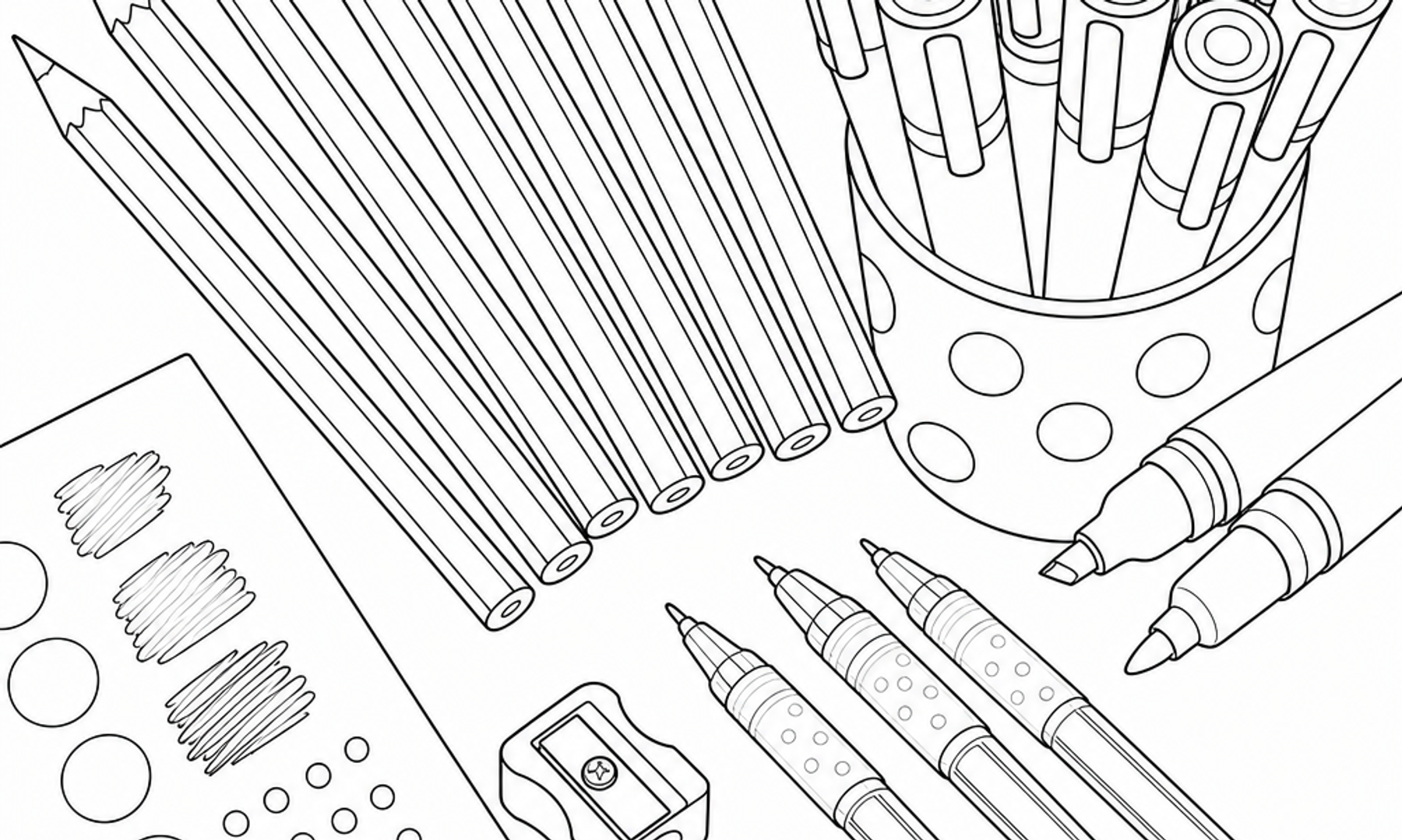
Walk into any art supply aisle and the choice can feel oddly heavy for something meant to be relaxing. Colored pencils, markers, gel pens, each wall of options promising a different kind of mark. The truth is simpler than it looks: there is no single "best" tool, only the one that matches your paper, your pace, and the kind of mark you want to leave behind.
This guide walks through the three most common tools for coloring pages, what each one does well, where it struggles, and how to choose without overthinking it. Coloring can be a self-care activity, but it is not art therapy or a substitute for mental-health care.
Colored Pencils: Slow, Layered, Forgiving
Colored pencils are often the first recommendation for anyone starting out, and for good reason. They are quiet, portable, and give you a wide margin for correction. If a color goes somewhere you didn't intend, a light touch and a bit of patience (or an eraser) usually fixes it.
What pencils do well
- Layering and blending. Because pencil pigment goes down in thin, controllable layers, you can build color gradually, deepen shadows, or soften a transition by going over it again.
- Detail work. A sharp point gets into small spaces, like the vein of a leaf or the lashes of an eye, better than most markers or gel pens.
- Texture play. Pressing harder darkens the color and fills the paper's texture (sometimes called "tooth") more completely, while a light hand leaves a softer, more open look.
Where pencils struggle
Colored pencils ask for time. Filling a large background area evenly can take far longer than with a marker, and very soft or heavily waxed pencils can start to feel slippery or saturated after many layers, making it hard to add more color.
A note on paper
According to artists interviewed by Legion Paper, a manufacturer of art papers, the texture and weight of the paper matters as much as the pencil brand itself. One colored pencil artist described needing a surface that is "toothy without being heavily textured" to hold dozens of light layers without flaking or becoming oversaturated (legionpaper.com). These are the preferences of individual working artists rather than a universal standard, but the underlying idea translates well to coloring pages: a smoother, sturdier page will usually take pencil layers more kindly than thin, lightweight paper.
Markers: Fast, Bold, Immediate
If colored pencils reward patience, markers reward confidence. A single stroke of a marker lays down a fuller, more saturated color than most pencils can achieve in one pass, which makes them satisfying for covering larger spaces quickly.
What markers do well
- Even coverage. Broad-tip markers fill in large shapes smoothly, which is useful for backgrounds, skies, or simple geometric designs.
- Vivid intensity. Marker ink tends to sit closer to full saturation right away, so colors read as bright and clean rather than built up gradually.
- Speed. For anyone who wants a finished page in one sitting, markers get there faster than pencils typically allow.
Where markers struggle
Markers are less forgiving. Once ink is down, it is down, and there is no erasing a stray mark. Many markers also bleed through thinner paper, which means the back of the page (or the page beneath it in a book) can end up stained. Testing a marker on a scrap corner of the same paper before committing to a large area is a simple habit that saves frustration later.
Gel Pens: Detail, Shimmer, and Outline Work
Gel pens occupy a smaller but distinct role. They are rarely the main tool for filling in large spaces, but they shine (sometimes literally, with metallic or glitter formulations) for outlining, adding dots, or layering tiny decorative details on top of pencil or marker work.
What gel pens do well
- Precision. The fine, controlled tip is well suited to small flourishes: dotted borders, tiny highlights, or linework that needs to stay crisp.
- Contrast and finish. A white or metallic gel pen can add a highlight on top of darker pencil or marker color, giving a page a sense of depth or sparkle that neither pencil nor marker alone provides.
- Layering on dark surfaces. Because gel ink is often more opaque than other inks, it can show up on darker papers where regular pens would disappear.
Where gel pens struggle
Gel pens are slow to cover large areas and can skip or smear if the ink hasn't fully dried before your hand passes back over it. They work best as an accent tool rather than a primary one.
Thinking in Terms of the Elements of Art
It can help to borrow a bit of vocabulary from visual art education when deciding which tool suits a particular page. The J. Paul Getty Museum's education resources describe color through three characteristics: hue, value (how light or dark), and intensity (how bright or dull) (getty.edu). These ideas translate directly into tool choice:
- If a section calls for subtle value changes (soft shading from light to dark), colored pencils give you the most control.
- If a section calls for high intensity and bold, flat color, markers deliver that immediacy.
- If a section calls for fine linework or texture accents, gel pens add detail without overwhelming the rest of the page.
There is no single correct choice here, just as the Getty material frames these elements as tools for observation rather than rules to follow. The page in front of you, and what you feel like doing with it today, can guide the decision as much as any technical rule.
Building a Beginner's Toolkit
For anyone just starting out, it helps to resist the urge to buy everything at once. A small, well-chosen set goes further than a large, overwhelming one.
A simple starting toolkit might include:
- A set of 24 to 36 colored pencils in a range of hues and at least a few value steps (light, medium, dark) of each
- A handful of broad-tip markers in neutral and accent colors for backgrounds
- One or two gel pens, ideally a white and a black, for highlights and outlines
- A sharpener with replaceable blades, since a dull pencil point changes how a line or fill looks
- A scrap piece of the same paper you're coloring on, for testing new tools before committing
Color charts are also worth the five minutes they take to make. Because pigment can look different once it's actually on the page compared to how it looks in the pack, a quick swatch test on your coloring paper helps you choose with your eyes rather than guessing.
Caring for Finished Pages
Once a page is finished, simple handling habits help it last. The Library of Congress's preservation guidance for works on paper, developed for archival and historic materials rather than everyday coloring pages, recommends handling paper with clean, dry hands, avoiding tape or rubber bands, and storing finished pieces flat in a cool, relatively dry space away from direct light (loc.gov). Your coloring page doesn't need museum-level conservation, but these same basics, clean hands, flat storage, and keeping it out of direct sun, will help the colors stay as vivid as the day you finished.
A Quiet Kind of Decision
Choosing a coloring tool is less about finding the "right" answer and more about noticing what kind of session you want to have. Some days call for the slow build of pencil layers; others call for the quick satisfaction of marker coverage; some pages just need a few gel pen highlights to feel complete. None of these choices needs to be permanent, and switching tools mid-page is entirely allowed.
If you're not sure where to begin, pick up whatever is already within reach and start with a small section of a page. You'll learn more about what you like from fifteen minutes of actual coloring than from an hour of comparing supplies online. Coloring Habitat has pages ready whenever you want to test out a new pencil, marker, or gel pen, so grab what's nearby and give yourself permission to simply begin.